
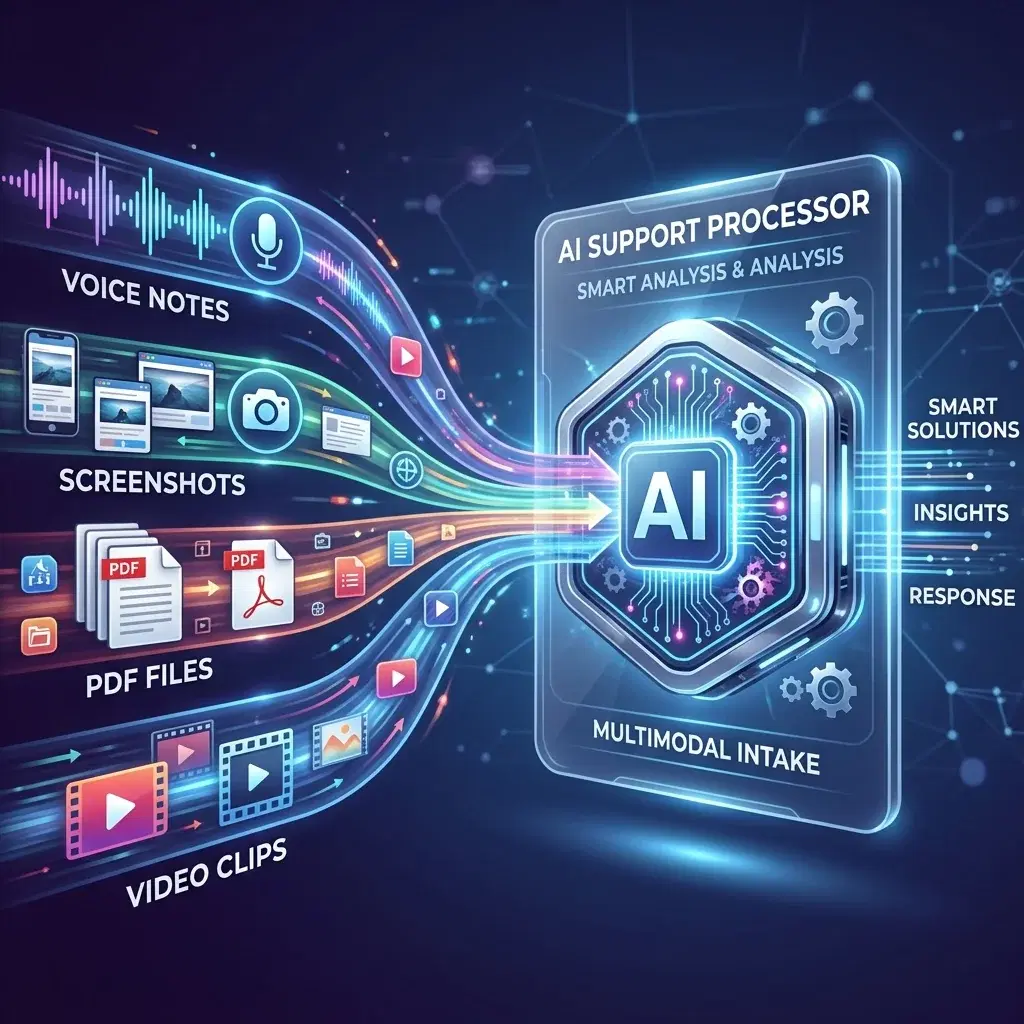
Most traditional chatbots are designed to understand only text. This worked well when customers mainly typed their queries. But today, customer behavior has changed. People now send voice notes, screenshots, PDFs, and even videos to explain their problems.
When customers are forced to convert everything into text, it creates friction. They spend extra time explaining issues that could be shown in seconds. This leads to delays and misunderstandings. These are common customer support challenges that businesses face today, and they are pushing forward-thinking companies toward multimodal AI customer support as the natural next step.
The Limits of Text-Only Customer Support
Traditional chatbots are limited to text-based inputs. They rely heavily on how well a user can explain their issue. This often leads to incomplete or unclear communication, longer resolution times, and frustrated customers who feel unheard.
When a customer encounters a software error, sending a screenshot is infinitely clearer than typing a technical description. When they have a billing question about a PDF invoice, uploading the document is faster than quoting numbers from it. Text-only systems create an unnecessary barrier between the customer and their resolution.
"Forcing customers to describe what they can simply show is not just inconvenient. It is a design failure that costs businesses trust, time, and revenue."
What is Multimodal AI in Customer Support?
Multimodal AI customer support refers to systems that can understand and process different types of inputs, not just text. This includes voice, images, documents, and videos. Instead of limiting customers to typing, it allows them to communicate naturally.
A key difference from traditional systems is flexibility. A customer can send a screenshot of an error instead of describing it. An AI that understands voice, images, and documents can analyze that input and respond accurately. This makes communication faster and more effective, and it aligns with how people already communicate in their everyday lives.
A voice note inside a messaging thread is different from a live phone conversation. When customers prefer to call, Dunefox Voice adds real-time spoken support, qualification, call transcripts, and human handoff to the wider Dunefox suite.
Why Modern Customers Communicate Beyond Text
Customer communication has evolved with messaging platforms and mobile usage. People now prefer quick and easy ways to share information. Sending a voice note is often faster than typing a long message. Sharing a screenshot is easier than explaining a technical issue line by line.
This shift reflects modern expectations. Customers want businesses to understand them without extra effort. This is why truly omnichannel customer communication is becoming essential. It aligns support capabilities with actual customer behavior, where convenience and speed matter most.
How Multimodal AI Works in Customer Support
Understanding how each input type is handled helps clarify the real-world impact of this technology.
• Understanding Voice Inputs
Multimodal AI can convert voice into text and understand the intent behind it. It processes the spoken message and provides a relevant response, making voice communication as effective and actionable as text.
• Processing Images and Screenshots
AI can analyze images to detect issues or extract information. A screenshot of an error message, for example, allows the system to identify the problem instantly without requiring the customer to describe it in words.
• Reading Documents and PDFs
Multimodal AI can scan documents and pull out key details. It can answer questions based on the content of uploaded files, reducing the need for manual review and supporting faster AI document processing in customer support workflows.
• Handling Video Inputs
AI can also process video inputs in meaningful ways. It can identify visual cues or understand the context of an issue shown on screen, which is especially useful for troubleshooting and guided support scenarios.
Key Benefits of Multimodal AI for Businesses
Businesses that adopt multimodal AI in customer service can see clear improvements in both performance and customer experience.
• Faster Issue Resolution
AI understands the full context from different inputs, reducing back-and-forth communication and allowing support teams to resolve queries in a single interaction.
• Improved Customer Experience
Customers can communicate in the way they prefer, which feels more natural, convenient, and respectful of their time.
• Reduced Manual Workload
Teams no longer need to review every file, audio message, or image manually. The AI handles initial processing, flagging only what needs human attention.
• Higher Efficiency and Scalability
More queries can be handled across more formats without increasing team size, making it cost-effective to grow support capacity.
• Unified Support System
All communication formats are managed in one place, improving consistency and making it easier for support teams to maintain context across conversations.
Real-World Use Cases of Multimodal AI Support
In real scenarios, multimodal AI simplifies communication in ways that text-only systems simply cannot match. Instead of typing a long explanation, a customer can send a screenshot. The system analyzes it and provides a solution in seconds.
Voice queries are handled instantly, without the need for typing. Documents like PDFs can be processed to extract useful information, whether it is a policy document, an invoice, or a form. These use cases span industries from fintech and insurance to e-commerce and education.
The flexibility of multimodal AI also enables businesses to serve customers across different demographics. Older customers who prefer speaking over typing, and mobile-first users who primarily communicate through images and voice notes, all benefit equally from this approach.
Multimodal AI vs Traditional Chatbots: What's the Difference?
Traditional chatbots are limited to text-based inputs. They rely heavily on how well a user can explain their issue, which often leads to incomplete or unclear communication. When a customer cannot find the right words, the chatbot fails them.
In contrast, multimodal AI understands multiple input types. It captures more context from the actual content being shared and provides better, more accurate responses. This makes it more efficient, more user-friendly, and ultimately more effective at resolving issues on the first attempt.
The difference lies in adaptability and intelligence. Multimodal systems do not just interpret words. They interpret intent, context, and content, regardless of the format it arrives in.
How Multimodal AI Reduces Support Team Workload
Support teams often spend significant time reviewing audio files, images, and documents manually. This process is slow, repetitive, and prone to human error. Multimodal AI removes this burden by handling these inputs automatically and surfacing only what requires human judgment.
It also reduces the need for repeated explanations. Customers can simply share what they have, and the system understands it. This shortens conversation length, reduces escalation rates, and lets support agents focus on complex, high-value interactions where human empathy truly matters.
The Future of Customer Support is Multimodal
Customer communication will continue to evolve. People will use more formats to share information, and the gap between what customers expect and what text-only systems can deliver will only widen. Businesses need to be ready for this change before it starts costing them customers.
AI will become more advanced and capable of understanding different input types with greater nuance. Companies that adopt these tools early will have a strong advantage. Text-only systems will soon feel outdated in comparison, and the transition will be non-negotiable for businesses that want to remain competitive.
Moving Beyond Text to Truly Understand Customers with Dunefox
Customer communication is no longer limited to text. People use voice notes, screenshots, documents, and even videos to explain their problems. Businesses that continue to rely only on text-based systems risk slowing down support and missing important context.
Dunefox is built to support this shift. It goes beyond basic chatbots by understanding inputs across voice, images, and documents. This allows businesses to communicate with customers in a more natural and efficient way. With a unified AI support system, Dunefox ensures faster responses, better accuracy, and less manual effort for support teams.
By combining intelligent automation with real understanding, Dunefox helps businesses deliver support that feels both efficient and human. Instead of forcing customers to adapt, it adapts to how customers already communicate.
Ready to Go Beyond the Text Box?
If your support system still depends only on text, it may already be falling behind. Explore Dunefox's multimodal AI capabilities and discover how your business can move toward a smarter, more natural approach to customer support.
Explore Dunefox AI WidgetFrequently Asked Questions
Support that handles whatever the customer sends, not just typed text. Voice notes, photos, screenshots, PDFs, and video all carry information, and a text-only bot forces the customer to describe something they have already shown you.