

Your customers message on WhatsApp, Instagram and your website, and your team answers from three different places with no shared record of who said what. A unified customer communication platform puts every channel in one thread per customer, with one customer record behind it. Not five browser tabs, and not a CRM with a chat widget bolted onto the side.
What does "unified" actually mean?
Most tools that call themselves unified are aggregators. They pull messages from several channels into one screen, and that is where it stops. Each channel keeps its own thread, its own contact entry and its own history.
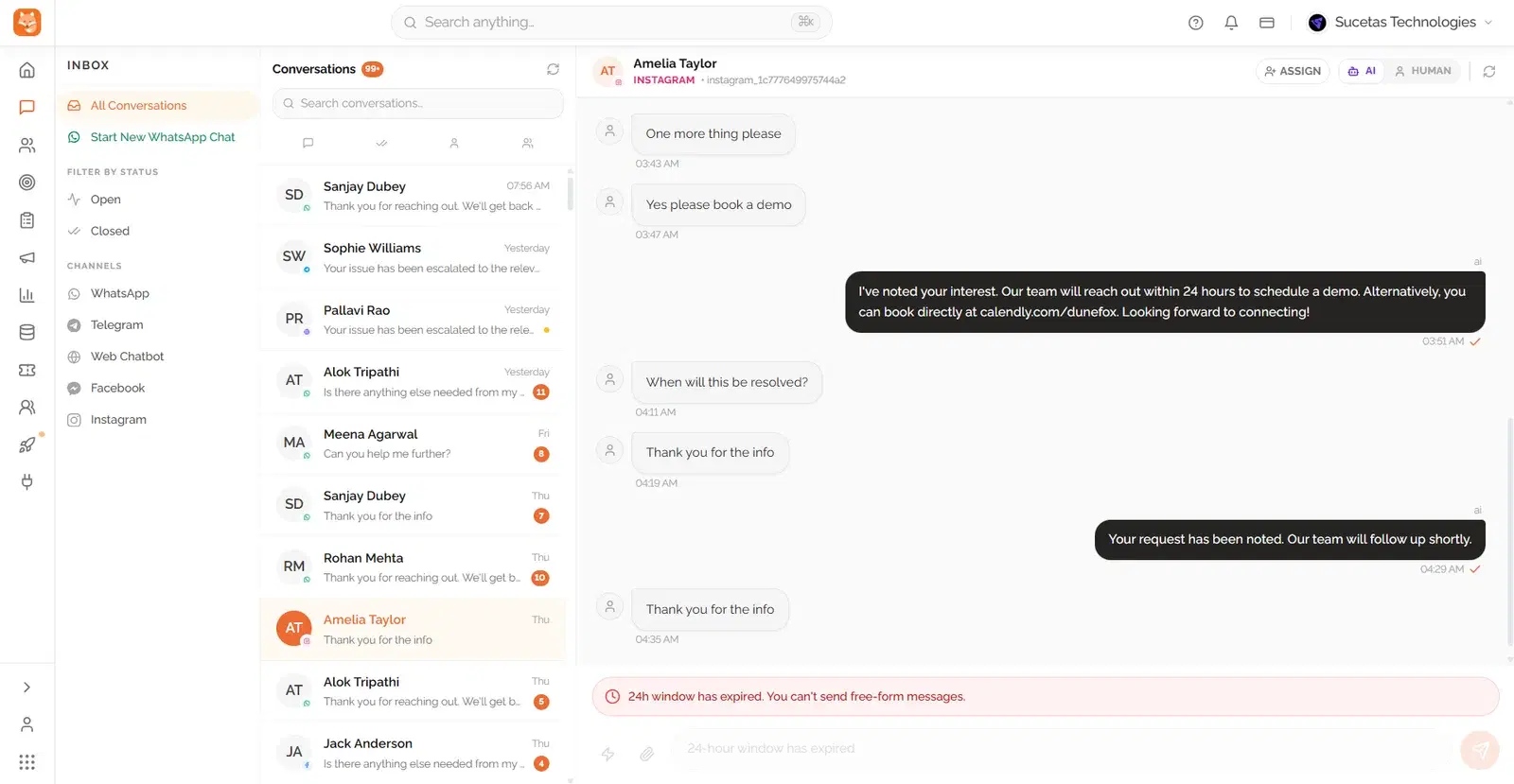
You find out at the point it matters. A customer asks about an order on Instagram on Monday, then follows up on WhatsApp on Thursday. In an aggregator those are two conversations with two different people as far as the system is concerned. Your agent opens the second one with no idea the first happened.
Unified means one thread per customer and one record behind it. The same person arriving on a different channel lands in the same conversation, because the platform matched them on their phone number or email before the message was ever shown to an agent.
Can one inbox handle WhatsApp, Instagram and web chat together?
Yes, and the honest answer is that the hard part is not the connecting. It is the rules.
Each channel has its own constraints and they are not interchangeable. WhatsApp requires Meta-approved templates for anything you send first, and it opens a 24-hour window when a customer messages you. Instagram limits when you can reply to a direct message. Web chat has no window at all, but the visitor leaves and the session ends.
A platform that treats all of them as the same pipe will quietly break on the first one that has a rule. What you want is one inbox for the agent and a set of rules underneath it, handled by the platform rather than by the person typing.
Dunefox carries WhatsApp, Instagram, Messenger, Telegram and web chat in one agent inbox, with the channel rules applied per channel and the thread kept per customer. The channels each connect from their own setup, and the agent sees one conversation.
What a unified platform has to do, in four parts
Receive on every channel your customers actually use
For most Indian SMBs that means WhatsApp first and everything else second, because WhatsApp is the customer's channel rather than a channel you chose.
Answer, including when nobody is at a desk
An AI agent handles the routine questions from your own documents and website, which is around 90% of them, and escalates the rest. It replies in the customer's language, in over 50 languages.
Record, so the conversation becomes a customer
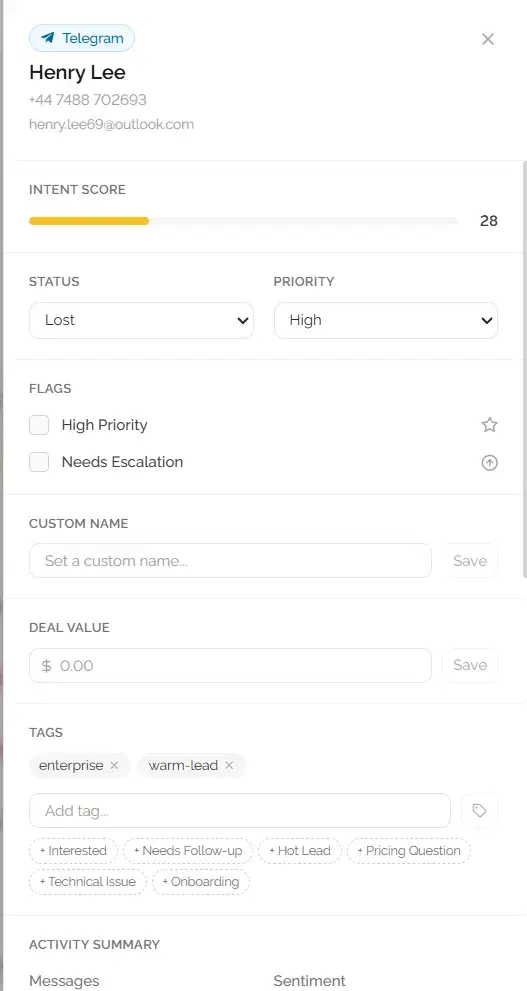
Every exchange attaches to a lead record with its own history, score, status and owner, rather than sitting as a loose message.
Hand over cleanly
When the AI reaches the edge of what it knows, or the customer asks for a person, the conversation moves to a teammate with a note explaining why. A handoff that drops the context is worse than no automation.
How is this different from a CRM with a chat widget?
A CRM with a chat widget starts from the record and bolts conversation on. A unified platform starts from the conversation, which is the part every other tool depends on.
The practical difference shows up in what you have to assemble. In a typical stack, a WhatsApp reply lives in one tool, the lead stage lives in a CRM, the campaign lives in a third, and moving information between them needs a connector. Three tools, three bills, and three places the customer record exists in a slightly different state.
In one schema, the reply, the stage change and the follow-up are the same record. There is no sync to break and no latency between the three. If you already run an established CRM, a unified platform connects to it rather than replacing it, which is why native integrations matter when you evaluate one. The Dunefox platform is built this way, with the shared inbox and the lead record as one object.
"A unified platform starts from the conversation, which is the part every other tool depends on."
Three questions that test whether a tool is really unified
Ask these in a demo. They take two minutes and they separate the aggregators from the rest.
- •Message the demo account from WhatsApp, then from the website chat using the same email. Does the platform show one customer or two?
- •Ask to see the lead record behind a conversation. If there is no record, or if it lives in a different product, the conversation and the pipeline are not the same object.
- •Ask what happens when the AI hands over. Watch whether the teammate receives any context or just an open chat window.
When you do not need this
If one person answers twenty messages a day on one number, you do not need any of this. The free WhatsApp Business app and a free web chat widget will do it, and they will do it for nothing.
The point at which that stops working is specific. More than one person has to answer the same number. Or you need a record of who said what. Or leads are being answered late and you cannot tell which ones. Or one person's personal WhatsApp is holding the pipeline and nobody else can see it.
Until one of those is true, a platform is overhead. When one of them is true, the scattered-tabs approach is already costing you more than the platform would.
See it in one inbox
The fastest way to judge whether a platform is unified is to message it twice from two channels and watch what happens. Start the 14-day trial, connect one number, and try it.
Start the 14-day trialFrequently asked questions
Q: What is a unified customer communication platform?
A system that receives customer messages from every channel into one thread per customer, answers them, records them against a single customer record, and hands them to a person when needed. The defining feature is one record per customer rather than one record per channel.
Q: Is a unified inbox the same as an omnichannel inbox?
In practice the terms are used interchangeably. What matters is whether the tool merges the same person across channels into one record, or simply displays several channels on one screen. Ask the question rather than trusting the label.
Q: Which channels should a small business connect first?
WhatsApp first if your customers message you there, which in India, Indonesia, the Gulf and much of South Asia they do. Then your website chat, then whichever social channel actually generates enquiries. Connecting a channel nobody uses adds noise rather than reach.
Q: Does a unified platform replace a CRM?
For most small and mid-sized teams, yes, because the lead record is built in. Larger teams running an established CRM usually keep it and connect the two, which is why native CRM integrations matter when you evaluate.
Q: How long does it take to set up?
Around ten minutes for a first working agent: add your website or documents so it has something to answer from, describe the agent's job, connect a number or the web widget, and choose who answers. Connecting more channels and tuning the handoff rules takes longer.
Q: What should the AI agent not be allowed to do?
Anything where a wrong answer is expensive or irreversible. Refunds, medical or legal guidance, contractual commitments, and payment disputes. Define those as handoff triggers before you go live rather than after.