
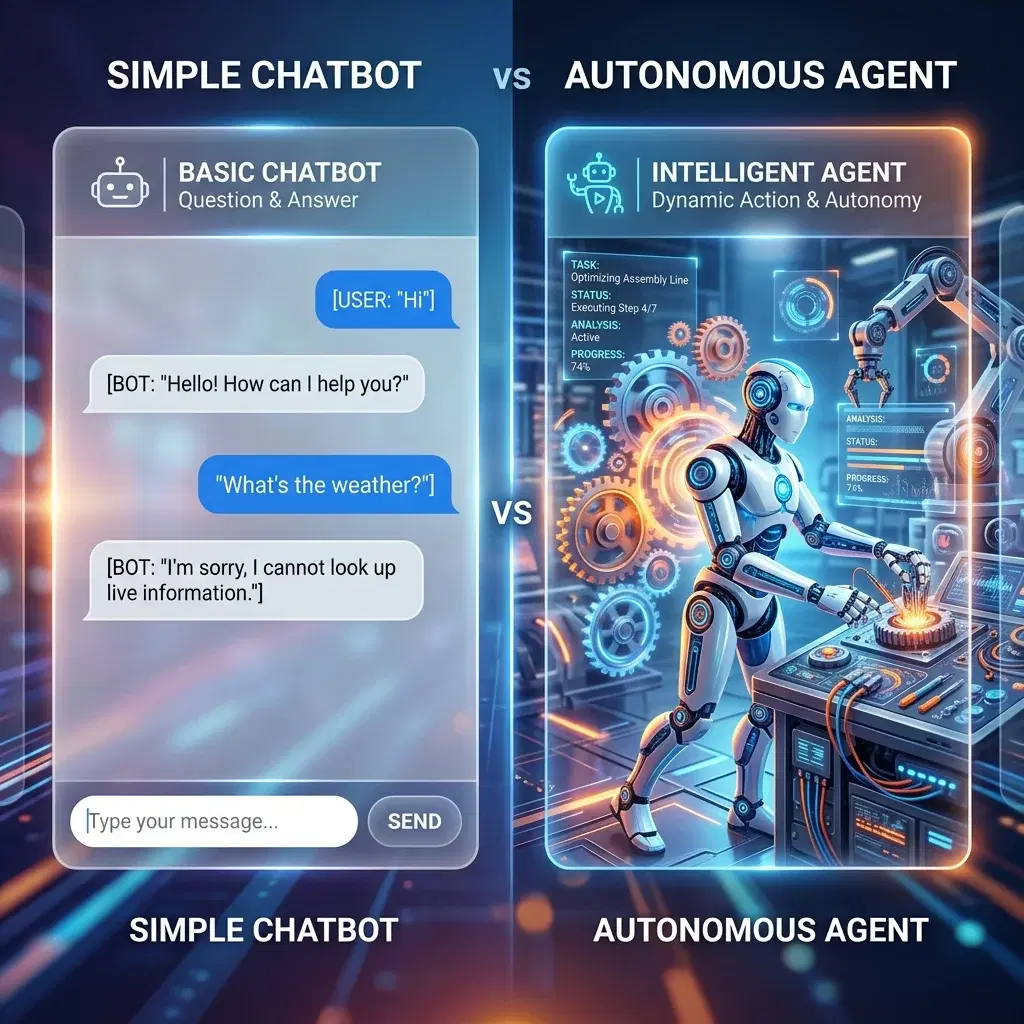
Every software vendor today claims their product is an "AI agent." But if you look closely, most of them are still just chatbots with a fancier label. This confusion is costing business owners real money they buy the wrong tool, get disappointing results, and blame AI altogether.
The truth is, AI chatbots and AI agents are fundamentally different. One talks. The other acts. And choosing the right one depends entirely on what your business actually needs to automate.
By the end of this post, you will know exactly what each tool does, where each one fits, and which one makes sense for your stage of growth.
What Is an AI Chatbot? (And What It Actually Does)
An AI chatbot is a software program that responds to questions in a conversation. You ask it something, it replies. Simple as that.
There are two types of chatbots worth knowing about. The first is a rule-based chatbot it follows a script, like a decision tree. If the customer says X, the bot says Y. The second is an AI-powered chatbot it uses large language models (like GPT) to understand natural language and give smarter answers. Most modern chatbots fall into this second category.
Here is where chatbots genuinely shine:
- FAQ handling: Answering common questions like pricing, hours, or return policies, instantly and 24/7.
- Lead capture: Collecting a visitor's name, email, and basic information before passing them to a salesperson.
- Appointment booking: Letting customers schedule calls or visits without any human involvement.
- Basic support triage: Sorting incoming queries and pointing customers in the right direction.
The key thing to understand about a chatbot is this: it stops after it replies. It answers your question, then waits. It does not follow up, does not take action inside other systems, and does not make decisions. It is reactive, not proactive.
When Is a Chatbot the Right Choice?
A chatbot is the right starting point if most of your customer queries are informational. Things like "What's your refund policy?" or "Do you deliver to Pune?" are perfect chatbot territory. It also makes sense if you are just beginning to automate and want a low-cost, low-risk entry point. A well-built chatbot can handle a large chunk of repetitive questions and free up your team's time significantly without a huge budget.
What Is an AI Agent? (And Why It Is Fundamentally Different)
An AI agent is not just a smarter chatbot. It is a completely different kind of system.
Where a chatbot responds to your question and stops, an AI agent receives a goal and works to complete it. It can think through the steps needed, connect to outside tools and databases, make decisions along the way, and take action all on its own.
Think of it this way. A chatbot is like a vending machine. You press a button, it gives you what is already inside. An AI agent is more like a personal assistant. You tell it what you need, and it figures out how to get it done.
Here is a real example. A customer messages your support system: "My order arrived damaged. I need a refund and a replacement." A chatbot would say something like, "I am sorry to hear that. Please fill out this form." An AI agent, on the other hand, would pull up the order details, process the refund, generate a return label, check inventory for a replacement, and send the customer a confirmation all in under a minute, with no human involved.
That is the difference between answering and acting.
When Does Your Business Actually Need an AI Agent?
Your business likely needs an AI agent if your workflows involve multiple systems for example, your CRM, payment gateway, and inventory database all need to talk to each other to resolve a single customer issue. You also need an agent if your team is doing a lot of manual, repetitive work that follows a pattern: copying data from one tool to another, following up on leads, or processing routine transactions. If scale and personalisation both matter to you, agents are built for exactly that.
AI Chatbot vs AI Agent: The Key Differences Side by Side
Here is a straightforward comparison to make the choice clearer.
| Feature | AI Chatbot | AI Agent |
|---|---|---|
| What it does | Responds to questions | Plans and executes tasks |
| Autonomy | Reactive waits for input | Proactive works toward a goal |
| System connections | Usually limited to one interface | Connects to CRMs, APIs, databases, tools |
| Memory | Limited or none | Can retain context across sessions |
| Task complexity | Simple, single-step | Complex, multi-step workflows |
| Cost to build | Lower upfront | Higher upfront, higher long-term ROI |
| Best for | FAQs, lead capture, triage | Automation, fulfilment, outreach, operations |
The simplest way to remember it: if the AI only talks, it is a chatbot. If it can decide what to do next and take action across tools, it is an AI agent.
One important warning here. Many vendors are now calling their chatbots "AI agents" because it sounds more impressive and justifies higher pricing. Before you pay for an "agent," ask one question: can it actually take actions inside other systems, or does it only generate text responses? That answer will tell you everything.
Real Business Use Cases: Chatbot vs Agent in Action
The easiest way to understand the difference is to see both tools applied to the same scenario.
Use Cases Where a Chatbot Is Enough
- E-commerce FAQ support. A customer visits your website and asks, "Do you offer free shipping?" Your chatbot answers instantly, 24/7, without a support agent lifting a finger. This is exactly what chatbots were built for.
- Lead qualification. A visitor lands on your services page. The chatbot asks a few questions company size, budget, timeline and collects their contact information before routing them to your sales team. Clean, simple, effective.
- Appointment reminders. A chatbot connected to your calendar can confirm bookings, send reminders, and answer basic pre-appointment questions. No human needed.
Use Cases That Demand an AI Agent
- End-to-end order management. A customer messages: "I want to change my delivery address and also apply a promo code to my existing order." That requires touching three systems the order database, the shipping integration, and the billing system. A chatbot cannot do this. An agent can.
- Proactive sales outreach. An AI agent can identify leads in your CRM that have gone quiet, draft personalised follow-up messages based on their history, send them, and log the activity without a salesperson doing anything. This kind of autonomous outreach is only possible with an agent.
- Multi-step customer onboarding. When a new client signs up, an agent can create their account, send a welcome email, schedule an onboarding call, add them to the right CRM pipeline, and notify the relevant team member all triggered by a single sign-up event.
The same distinction applies to phone conversations. A business AI voice assistant does more than play a recorded response. It understands the caller, retrieves approved information, qualifies intent, books the next step, and records the outcome for follow-up.
Cost and ROI: What Should You Actually Budget For?
Cost is where most business owners get stuck. Here is an honest breakdown.
A chatbot, especially a SaaS-based one, is relatively affordable. Good platforms typically range from $50 to $500 per month depending on features and message volume. A custom-built AI chatbot tailored to your business will cost more upfront but gives you more control. For businesses at an early stage of automation, chatbots offer a solid return on a modest investment.
AI agents cost more to build and set up. They require integrations, planning, and proper architecture. However, the ROI calculation looks very different at scale. A chatbot lowers the cost of answering questions. An agent eliminates entire workflows that is a much bigger financial impact. When you factor in the hours your team spends on repetitive manual work, an agent often pays for itself within two to three months of deployment.
One thing to be clear about: AI agents are not only for large enterprises anymore. With the right automation partner, even a 10-person business can deploy a working AI agent for the right workflow without a six-figure budget. The key is to match the tool to the problem not to over-engineer from day one.
Which One Does Your Business Actually Need? (5 Questions to Decide)
This is the question the whole post has been building toward. Answer these five questions honestly.
- Are most of your customer queries informational? If the majority of what your team answers every day is questions not tasks a chatbot will likely handle 70–80% of that volume effectively.
- Do your workflows involve three or more systems? If resolving a single customer issue requires touching your CRM, your inventory system, and your payment gateway, you need an agent, not a chatbot.
- Is your team doing repetitive manual work that follows a pattern? If yes, that work is automatable with an agent. Copy-paste tasks, follow-up emails, data transfers, report generation these are all agent territory.
- Do you need your AI to act proactively, not just reactively? Chatbots wait to be asked. Agents can initiate. If you want your AI to follow up on a lead who has not replied in 48 hours, you need an agent.
- Are you handling more than 100 customer interactions per day? At this volume, the efficiency gains from an agent rather than a chatbot become significant and measurable.
If you answered yes to two or fewer questions, a chatbot is a smart, cost-effective starting point. If you answered yes to three or more, you are ready for an AI agent and the ROI will justify the investment.
Not sure how to score your own business? That is exactly what a discovery call with an AI automation specialist is for.
Conclusion: Don't Let the Jargon Make the Decision for You
The difference between a chatbot and an AI agent is not just technical terminology. It is the difference between answering a question and solving a problem. One responds. The other acts. That is where Dunefox comes in.
At Dunefox, we do not sell you a tool and wish you luck. We start by understanding your business your bottlenecks, your systems, and your goals. Then we build the right solution: whether that is a focused AI chatbot, a full AI agent, or a hybrid of both working together. Our team has built automation workflows for businesses across e-commerce, SaaS, real estate, and professional services and we have seen first-hand that the right fit matters far more than the fanciest technology.
If you are still not sure which one your business needs, that uncertainty is exactly what we help you resolve. Book a free 30-minute AI automation discovery call at dunefox.io and we will give you an honest answer no sales pressure, just clarity.
Ready to find out if your business needs a chatbot or an AI agent?
Book a free discovery call