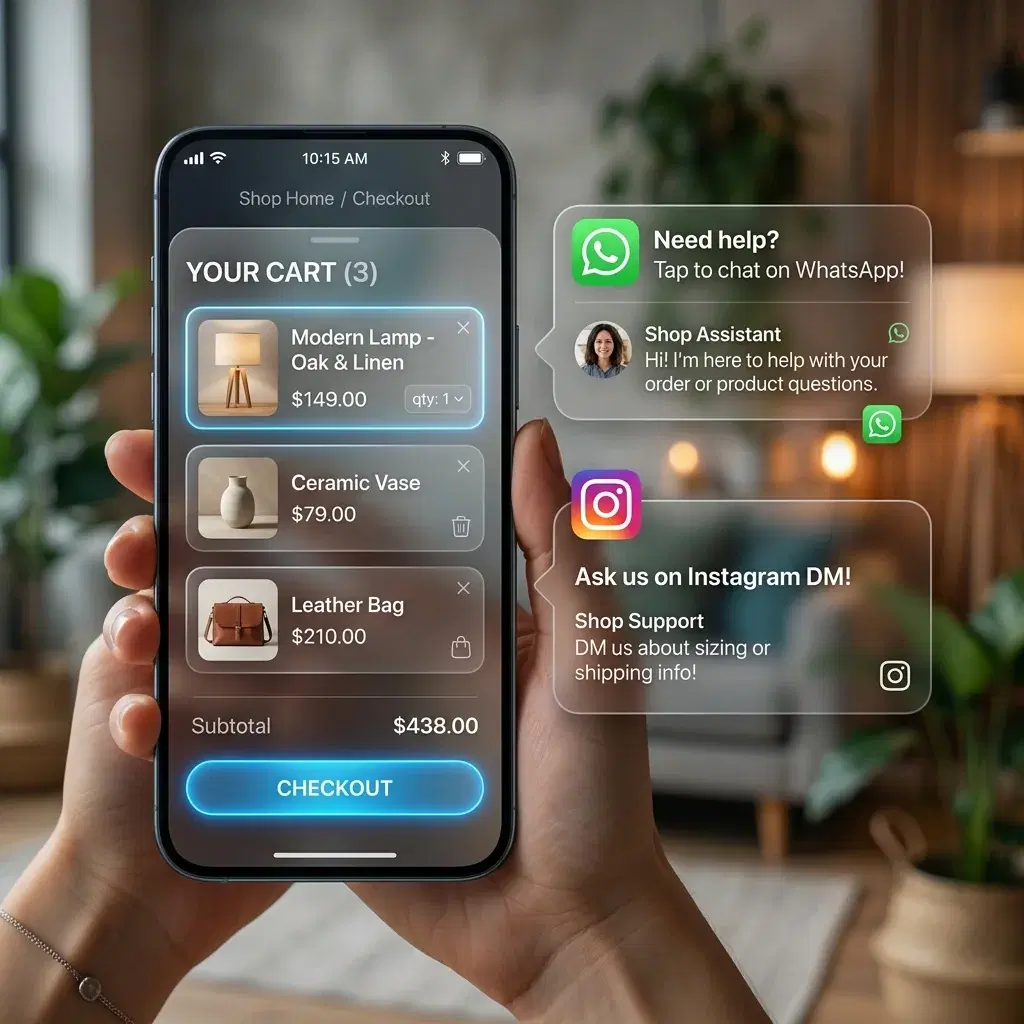
Conversational commerce turns customer conversations into sales opportunities.
Instead of browsing products on websites and checking out through forms, customers chat with businesses directly through messaging apps like WhatsApp, Instagram, Facebook Messenger, or live chat widgets.
The conversation becomes the shopping experience. Customers ask questions, get instant answers, and complete purchases without leaving the chat. Businesses sell more because they engage customers when interest is highest.
This approach works because it mirrors how people naturally make buying decisions. You ask friends for recommendations, compare options through discussion, and trust personal advice over generic product descriptions. Conversational commerce brings that human touch to digital sales.
How Conversational Commerce Works
Conversational commerce happens across multiple touchpoints in a single unified system. A customer might discover your product on Instagram, ask questions through Instagram DM, continue the conversation on WhatsApp, and complete the purchase through a chat-based checkout flow.
The key is maintaining conversation context across all channels. When a customer switches from Instagram to WhatsApp, the business remembers what was already discussed. No starting over. No repeating information.
AI automation handles initial responses and common questions. When conversations need human expertise, they transfer seamlessly to your team with full context. Your staff sees the entire conversation history instantly.
Modern conversational commerce platforms track every interaction across channels. You see which conversations drive revenue, which questions predict purchases, and which touchpoints need optimization.
The Business Impact of Conversational Commerce
Companies using conversational commerce report dramatic improvements in key metrics. Real conversations convert better than anonymous website browsing.
- Response time becomes a competitive advantage: Businesses answering Instagram DMs and WhatsApp messages within minutes capture sales that competitors miss. Social media users expect instant responses.
- Revenue impact compounds over time: Happy customers share positive experiences, driving referral traffic. Each conversation builds your brand reputation.
- Automation amplifies human effort: AI handles repetitive questions about pricing and shipping. Your team focuses on complex inquiries that close bigger deals.
"Real conversations convert better than anonymous website browsing. Bringing a human touch directly to the messaging apps your customers already use transforms sales."
Key Channels for Conversational Commerce
Leads global adoption with over 2 billion users. WhatsApp Business API enables automated responses, catalog sharing, and payment processing within chat.
• Instagram & Facebook Messenger
Customers discover products through posts and message directly. Instagram Shopping features let users browse and purchase without leaving the app.
• Website Chat Widgets
Captures visitors when interest peaks. Instant chat availability converts strong buying intent on pricing or product pages into sales.
• Telegram
Offers advanced automation features and supports large group communications. Great for customer updates and direct sales conversations.
Phone calls remain an important conversational channel for higher-value or time-sensitive purchases. A Dunefox AI voice assistant can qualify the caller, answer product questions from approved content, and book the next sales step.
Conversational Commerce vs Traditional E-commerce
Traditional e-commerce optimizes for self-service browsing. Customers navigate product pages, compare options through filters, and complete purchases through checkout forms.
Conversational commerce optimizes for relationship building. Every interaction teaches you about customer needs, preferences, and buying timeline. You gather insights through direct conversation rather than inferring from clicks.
The sales process becomes collaborative instead of transactional. Customers co-create solutions through back-and-forth discussion. Recovery opportunities also multiply. When someone stops responding in chat, you still have their context for personalized follow-up.
AI and Automation in Conversational Commerce
AI automation handles the volume while humans handle the value. Businesses receive hundreds of similar questions about store hours, return policies, and product availability. AI answers these instantly.
- Smart Routing: AI analyzes message content and customer history to assign conversations appropriately. High-value leads go to senior sales staff.
- Automated Sequences: Someone who asks about pricing but doesn't buy immediately enters a follow-up sequence with helpful content and special offers.
- Conversation Memory: AI remembers customer preferences and ongoing issues across all channels, preventing frustrating repetition.
Common Conversational Commerce Use Cases
Product Discovery: Instead of browsing category pages, customers describe what they need and get personalized recommendations.
Customer Support to Sales: Someone asking about return policies might be considering a larger purchase. Training teams to recognize buying signals increases revenue.
Appointment Booking: Customers prefer discussing availability and pricing through chat rather than complex forms, clarifying expectations and reducing no-shows.
Cart Abandonment Recovery: Instead of generic emails, send specific WhatsApp messages addressing the exact products and potential concerns.
Measuring Conversational Commerce Success
Conversation-to-conversion rates matter more than traditional e-commerce metrics. Track how many chat conversations result in purchases.
Response time directly impacts sales outcomes. Measure average response times across channels. Revenue attribution reveals which touchpoints drive sales. Finally, conversation quality metrics predict long-term success, like customer satisfaction scores and repeat purchase rates.
Getting Started with Conversational Commerce
Choose your primary channel based on where your customers already communicate. B2B companies often succeed with LinkedIn messaging and website chat. Consumer brands typically see better results with WhatsApp and Instagram.
Start with common questions that slow down your sales process. Integrate your existing tools rather than replacing everything. Finally, train your team on conversation-first selling, role-playing scenarios to feel natural rather than scripted.
The Future of Conversational Commerce
Voice integration will expand conversational commerce beyond text. Video integration within messaging apps will create richer product demonstrations, like real-time video walkthroughs.
AI will predict customer needs before they ask, proactively suggesting products. Cross-platform orchestration will become seamless, allowing customers to continue across channels without losing context.
Ready to Transform Your Customer Conversations?
Conversational commerce transforms every customer interaction into a revenue opportunity. By meeting customers where they already communicate and providing instant, personalized responses, businesses capture sales that traditional e-commerce approaches miss.
The companies succeeding focus on relationship building over transaction processing. They use automation to handle volume while ensuring human expertise reaches high-value conversations.
Ready to see how conversational commerce can transform your business? Dunefox's unified inbox manages customer conversations across WhatsApp, Instagram, Facebook, Telegram, and website chat in one platform. Our AI automation handles common questions while routing qualified leads to your sales team with complete conversation context.
Turn conversations into customers
Start your free 14-day trial and discover how conversational commerce can turn every customer conversation into a growth opportunity.
Start Free TrialFrequently Asked Questions
Selling through a conversation instead of a checkout form. The customer asks about a product on WhatsApp, Instagram, or web chat, gets a recommendation, and completes the purchase in that thread rather than being sent off to browse a catalogue alone.