
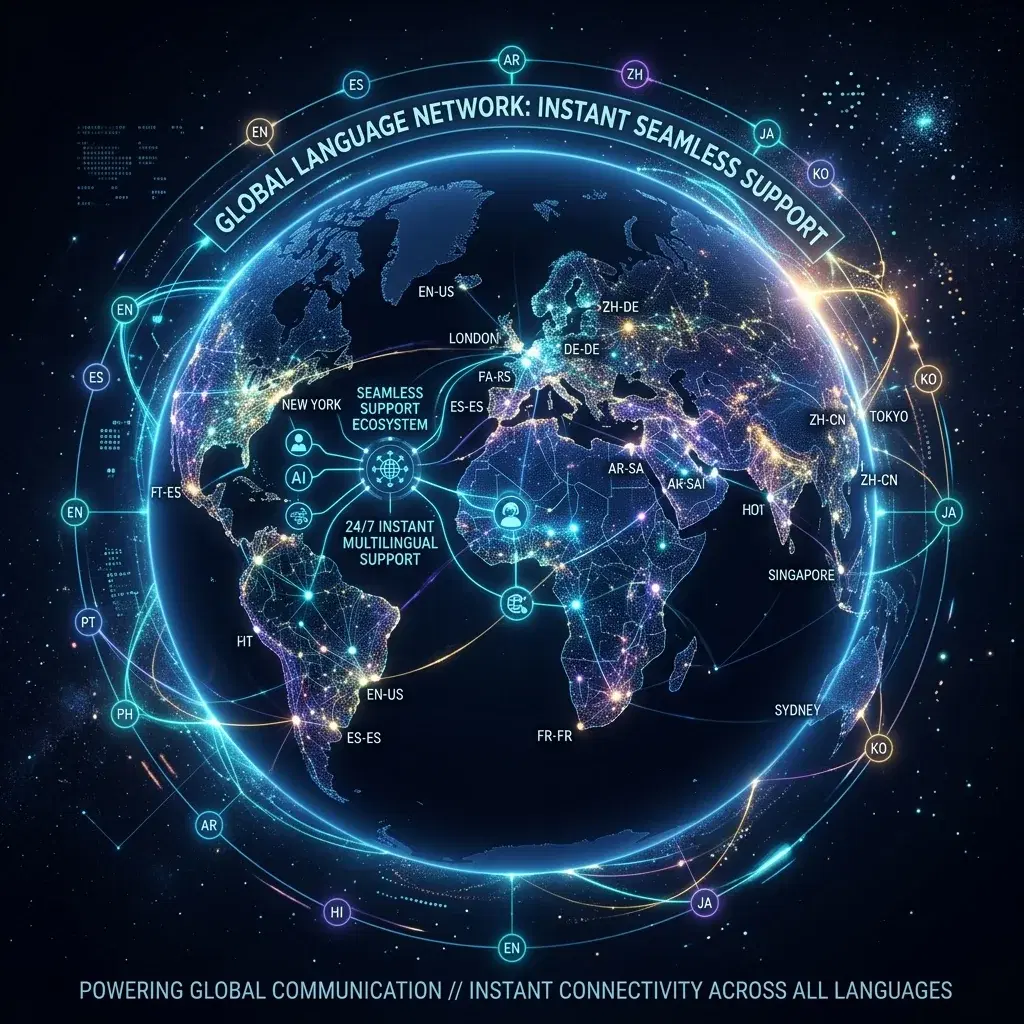
A few years ago, serving customers in different countries meant building large support teams. Businesses had to hire agents for every language, train them, and manage support across different time zones. That model worked for some companies, but it came with high costs and slow scaling. Today, businesses have a better option with Multilingual AI Support.
Customers now expect fast answers, clear communication, and support in their own language. They do not want to wait for business hours or struggle with poor translations. If your company is growing internationally, language can quickly become a barrier. This is where AI customer service automation can change how support works.
Instead of hiring more agents for every market, companies can now use AI to support customers in 50 or more languages. This helps businesses grow faster while keeping support costs under control. In this guide, you will learn how global customer support works with AI, why companies are adopting it, and how you can implement it in your own business.
Why Global Businesses Struggle With Multilingual Customer Support
Expanding into international markets sounds exciting. More customers usually means more revenue and stronger brand growth. But many businesses discover that customer support becomes harder as they enter new countries. Supporting customers in different languages creates challenges that many teams are not ready for.
The first challenge is hiring. Finding skilled support agents who speak multiple languages takes time and money. Even after hiring, businesses still need to train these agents on products, systems, and company processes. This slows down growth and increases operational costs.
Another issue is consistency. A customer in Germany may receive a different experience than a customer in Japan or Brazil. When support quality changes between regions, trust can drop. That can hurt retention and customer satisfaction.
Time zones also create pressure. Customers expect quick replies at any hour. Human teams cannot always provide true 24/7 service without adding more staff. This makes international customer support expensive to scale.
What Is Multilingual AI Support?
Multilingual AI Support uses artificial intelligence to communicate with customers in many languages. It can understand customer questions, detect language automatically, and respond in a natural way. Instead of simply translating words, modern AI tries to understand the meaning behind the message.
This is very different from old translation tools. Translation software changes text from one language to another, but it often misses context. AI support systems understand customer intent, product questions, and support history before replying. That creates a much smoother customer experience.
Many businesses use AI across channels like websites, live chat, email, and messaging apps such as WhatsApp. Some also use voice AI for multilingual phone calls. Dunefox Voice extends the Dunefox suite to phone calls in more than fifty languages.
How Multilingual AI Support Works in Real Time
Imagine a customer from Spain visits your website and asks a question in Spanish. The AI first identifies the language. Then it studies the customer's message to understand what help is needed.
After that, the system checks your company knowledge base, support articles, or product data. It creates a helpful response in Spanish and sends it back in seconds. The customer gets fast support without waiting for a human agent.
If the question is too complex, the AI can transfer the conversation to a human team member. It also shares the full conversation history. This allows AI live chat systems to work together with human teams instead of replacing them completely.
Benefits of Using AI for Global Customer Support
Businesses are adopting customer support automation because the benefits are practical and measurable. Here are some of the biggest advantages.
- Support Customers in 50+ Languages: AI can communicate in dozens of languages at the same time. This makes it easier to enter new markets without building separate support teams. Customers feel more comfortable when they can ask questions in their own language.
- Reduce Support Costs: Hiring, training, and managing support agents can be expensive. AI helps reduce these costs by handling repetitive conversations. Human agents can then focus on more complex cases.
- Provide 24/7 Availability: AI never sleeps or takes shifts. Customers can get help at any time, even on weekends or holidays. This improves the customer experience across time zones.
- Improve Response Speed: Customers dislike waiting. AI can answer common questions in seconds. Faster responses often lead to higher satisfaction and stronger trust.
- Keep Your Brand Voice Consistent: AI can be trained on your company's tone, product information, and policies. This means customers receive consistent answers no matter where they are. That helps build brand credibility.
These benefits make 24/7 AI customer support valuable for companies that want to grow internationally.
Multilingual AI Support vs Hiring More Agents
When companies face growing support demand, their first thought is often to hire more people. That may solve short-term issues, but it usually creates long-term complexity. More hiring means more payroll, training, scheduling, and management.
With customer service automation, businesses can scale support faster. AI can handle thousands of conversations at once. Human teams simply cannot do that without major staffing increases.
This does not mean human agents become unnecessary. Human support is still critical for emotional, sensitive, or complex situations. The real value comes when AI handles routine conversations while people handle deeper customer needs.
Which Industries Benefit Most?
Many industries are already using multilingual chatbot software to serve global customers. Software companies use AI to answer product questions, guide onboarding, and solve technical issues. E-commerce brands use it to handle order tracking, refunds, and shipping updates.
Businesses using platforms like Shopify often need customer support across multiple countries. Financial technology companies connected with Stripe also deal with global customers who need fast answers. Customer-focused teams inspired by platforms like HubSpot use automation to improve response times.
Travel companies, education businesses, and healthcare support teams also benefit. Any business serving customers across borders can gain value from conversational AI.
How to Implement Multilingual AI Support
The first step is understanding where your customer conversations happen. Some customers may contact you through your website. Others may prefer email or messaging apps like WhatsApp.
Next, study your customer data. Find out which languages your customers speak most often. Start with your top markets before expanding further.
Then train your AI with support articles, product details, FAQs, and common customer questions. The more relevant knowledge the AI has, the better it performs. Over time, you can improve performance by reviewing conversations and updating your training data.
This process makes AI implementation for customer service much more effective.
Is Multilingual AI Support Right for Your Business?
If your business is entering new markets, support demand will grow. If your team struggles with slow response times, language barriers, or rising support costs, AI may be the right next step.
Startups often use AI customer support solutions to grow without adding too many employees. E-commerce brands use it to serve buyers across multiple regions. SaaS companies use it to onboard and support users worldwide.
The question is no longer whether AI can support global customers. The real question is how quickly your business can adopt it before competitors do.
Conclusion: The Future of Global Customer Support Is AI
Serving customers across countries is no longer just about being available. It is about being available in the right language, on the right channel, and at the right moment. Businesses that still rely only on traditional support teams often struggle with rising costs, slower response times, and inconsistent customer experiences.
That is why Multilingual AI Support is becoming a major advantage for modern businesses. With the right AI system, companies can support customers in 50+ languages, stay available 24/7, and scale globally without constantly increasing headcount.
Platforms like Dunefox stand out because they go beyond simple chatbot automation. Dunefox combines multilingual AI conversations, WhatsApp and web automation, intelligent routing, ticket management, and human handoff workflows in one platform. According to Dunefox, businesses can automate up to 90% of repetitive customer queries while keeping support quality high across channels.
Ready to automate multilingual support for your global customers?
Book a free discovery callFrequently Asked Questions
Dunefox supports over 50 languages natively including English, Hindi, Spanish, French, German, Arabic, and regional Indic languages.